


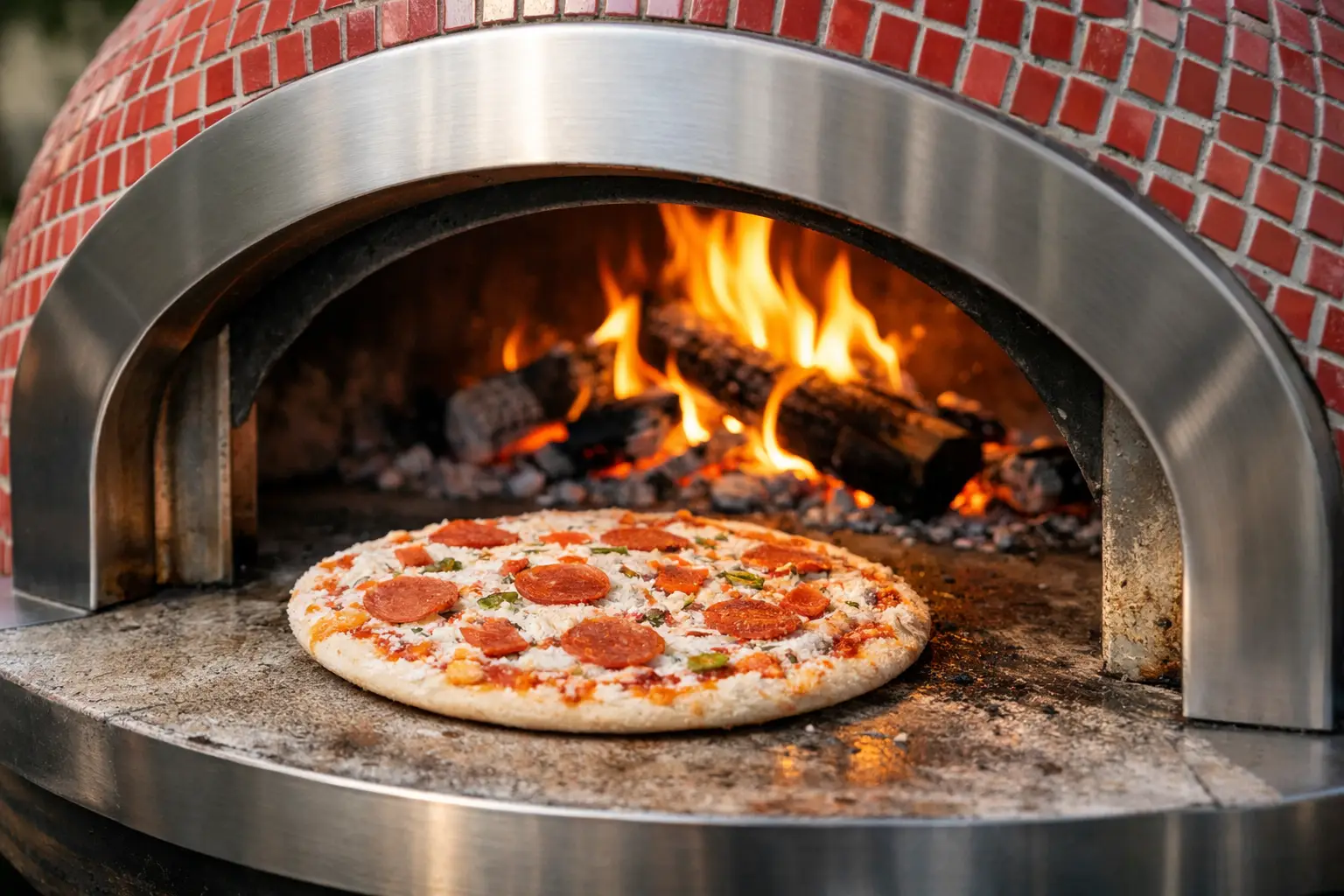
21 Apr Can You Cook a Frozen Pizza in a Wood Fired Pizza Oven?
A frozen pizza can go from pale and forgettable to genuinely impressive in a real wood-fired oven – or it can scorch in 40 seconds and leave the center cold. That is why the question, can you cook a frozen pizza in a wood fired pizza oven, deserves a more honest answer than a simple yes or no.
Yes, you can. But whether you should cook it exactly like a fresh Neapolitan pie is another matter. A handcrafted masonry oven runs hotter, stores heat longer, and cooks more aggressively than the average home appliance. Frozen pizza was designed around the slower, more controlled environment of a standard kitchen oven. If you approach both the same way, the results are usually uneven.
Can You Cook a Frozen Pizza in a Wood Fired Pizza Oven?
Absolutely – provided you manage the fire and floor temperature with intention. In a true wood-fired oven, especially one built with real firebrick and proper thermal mass, radiant heat from the dome and conductive heat from the cooking floor are far more intense than what a boxed frozen pizza expects.
That difference matters. A thin frozen crust can burn on the bottom before the cheese fully melts. Toppings can blister too quickly. If the pizza is still deeply frozen when it hits an overly hot floor, the exterior may race ahead while the interior lags behind.
The good news is that a premium oven gives you more control, not less. Once you understand how to use retained heat, fire position, and timing, frozen pizza becomes easy to handle. It just stops being a set-it-and-forget-it exercise.
Why Frozen Pizza Behaves Differently in a Wood-Fired Oven
Fresh artisan dough and mass-produced frozen pizza are built for different cooking environments. Fresh dough thrives in extreme heat because it is supple, lightly topped, and meant to spring quickly. Frozen pizza tends to be denser, drier, and pre-structured to cook over several minutes rather than several seconds.
A proper wood-fired oven can exceed 800 degrees at the dome and maintain a very hot cooking floor. That is ideal for authentic Neapolitan pizza. It is less forgiving for a supermarket pie with processed cheese, heavy toppings, and a crust designed for a 425 to 450 degree kitchen oven.
There is also the issue of moisture. Frozen pizzas release steam as they heat. In a conventional oven, that moisture has more time to evaporate gradually. In a live-fire environment, intense bottom heat can crisp one area while steam remains trapped in another. The result can be a crust that is charred underneath but soft in the middle.
This does not mean frozen pizza is a poor fit for a wood-fired oven. It means it needs a different zone, a different temperature, and a more attentive hand.
The Best Temperature for Frozen Pizza
If you want balanced results, avoid full Neapolitan temperatures. For frozen pizza, the sweet spot is usually a moderate wood-fired environment rather than a roaring flame with a blistering-hot floor.
In most cases, a floor temperature around 550 to 650 degrees works well. That gives the crust time to thaw, cook through, and crisp without instantly blackening. The live flame should still be present, but it should be controlled and positioned to one side rather than aggressively rolling over the entire dome.
This is where a well-built oven shows its value. Ovens with substantial masonry and real firebrick do not just generate heat – they hold it evenly. That allows you to cook with retained heat and gentler live fire instead of relying on constant blast-furnace intensity.
If your oven is fresh from a high-heat firing, let it settle before cooking frozen pizza. A brief cooling period can make the difference between a pizza that is evenly finished and one that is burned on contact.
Floor heat matters more than people expect
Many owners focus on flame and dome temperature, but frozen pizza often succeeds or fails at the hearth. If the floor is too hot, the crust can scorch before the toppings are ready. If the floor is too cool, the pizza may dry out before it gains proper structure.
Checking the cooking surface before launching is worth the extra moment. In a premium oven, the floor remains active long after the flames look manageable.
How to Cook Frozen Pizza in a Wood Fired Pizza Oven
The process is simple once you stop treating frozen pizza like a 90-second artisan pie. Build your fire, bring the oven to temperature, then let it settle into a moderate cooking range. Push the fire to the side and clear a clean cooking area on the hearth.
At that point, you have a choice. You can place the pizza in straight from frozen, or let it soften slightly for a few minutes at room temperature. A brief tempering period often helps with more even cooking, especially on thicker pizzas, but you do not want it to become limp.
Launch the pizza away from the flame, but not so far that it sits in a dead zone. You want steady top heat without direct punishment. Then watch it closely. Unlike a conventional oven, a wood-fired oven rewards attention. Rotate the pizza as needed so the side facing the fire does not outpace the rest.
Most frozen pizzas will cook in just a few minutes at this lower wood-fired range, though exact time depends on thickness, toppings, and oven temperature. Thin-crust styles move quickly. Deep-dish or heavily loaded pizzas need more patience and sometimes a slightly cooler zone.
A screen or tray can help
Purists may prefer pizza directly on the brick, but frozen pizza is one of the rare cases where a screen or tray can be useful. It creates a buffer against excessive bottom heat and gives the top a chance to catch up. For owners learning their oven, this can be a smart transition technique.
Once you understand how your hearth behaves, you may find that direct-floor cooking is still possible – just not at the same temperatures you would use for fresh dough.
Common mistakes when cooking frozen pizza in a wood-fired oven
The biggest mistake is cooking too hot. People see dramatic flames and assume hotter means better. For frozen pizza, it usually means burned crust, scorched cheese, and an underheated center.
The second mistake is ignoring rotation. Wood-fired heat is directional. The side facing the flame almost always cooks faster. If you leave the pizza untouched, one edge can char while the opposite side remains pale.
The third mistake is choosing the wrong pizza. Not every frozen pizza performs well in high-heat conditions. Very sugary sauces can darken too fast. Thick layers of cheese can separate. Some bargain crusts simply are not built to handle direct hearth cooking.
There is also a quality question worth acknowledging. A luxury oven can absolutely improve a frozen pizza, but it cannot turn a poor product into an exceptional one. Better ingredients still matter. If the goal is convenience with elevated results, start with a frozen pizza that has a relatively clean ingredient deck and a crust with some structure.
Is it worth using a premium wood-fired oven for frozen pizza?
For a quick lunch, a family movie night, or a busy gathering, yes. A wood-fired oven does not need to be reserved only for hand-stretched dough and imported mozzarella. One of the pleasures of owning a serious oven is versatility.
That said, a premium masonry oven reveals its full value when cooking real pizza from fresh ingredients. The heat retention, the live-fire character, the visual impact, and the architectural presence are all part of a larger experience. Frozen pizza may be convenient, but it is not the ceiling of what the oven can do.
For homeowners designing an outdoor kitchen or entertaining space, this distinction matters. An authentic brick oven is not just another appliance. It becomes the centerpiece of the patio, the anchor of the gathering, and a long-term investment in both performance and presentation. Brands such as Forno Nardona build around that idea – that true craftsmanship should deliver everyday usability while also offering old-world cooking capability that mass-market units simply cannot match.
When frozen pizza makes sense – and when fresh is better
Frozen pizza makes sense when speed matters more than ritual. It is practical for weeknights, casual entertaining, or feeding children without turning the evening into a full production.
Fresh pizza is better when you want to take advantage of what a wood-fired oven was truly built to do. That is where high heat becomes an asset rather than a complication. Fresh dough, balanced toppings, and active flame create the airy crust, leopard spotting, and clean finish people associate with authentic oven performance.
If you own a serious wood-fired oven, it is reasonable to do both. Use frozen pizza when convenience wins. Use fresh dough when you want the oven to speak for itself.
A well-made wood-fired oven gives you that flexibility, but it also teaches you something quickly – the better the oven, the more technique matters. Frozen pizza can absolutely work, and it can work well, as long as you respect the heat and cook with intention rather than habit. That small shift is often what turns a convenience meal into something surprisingly worthy of the oven beneath it.