


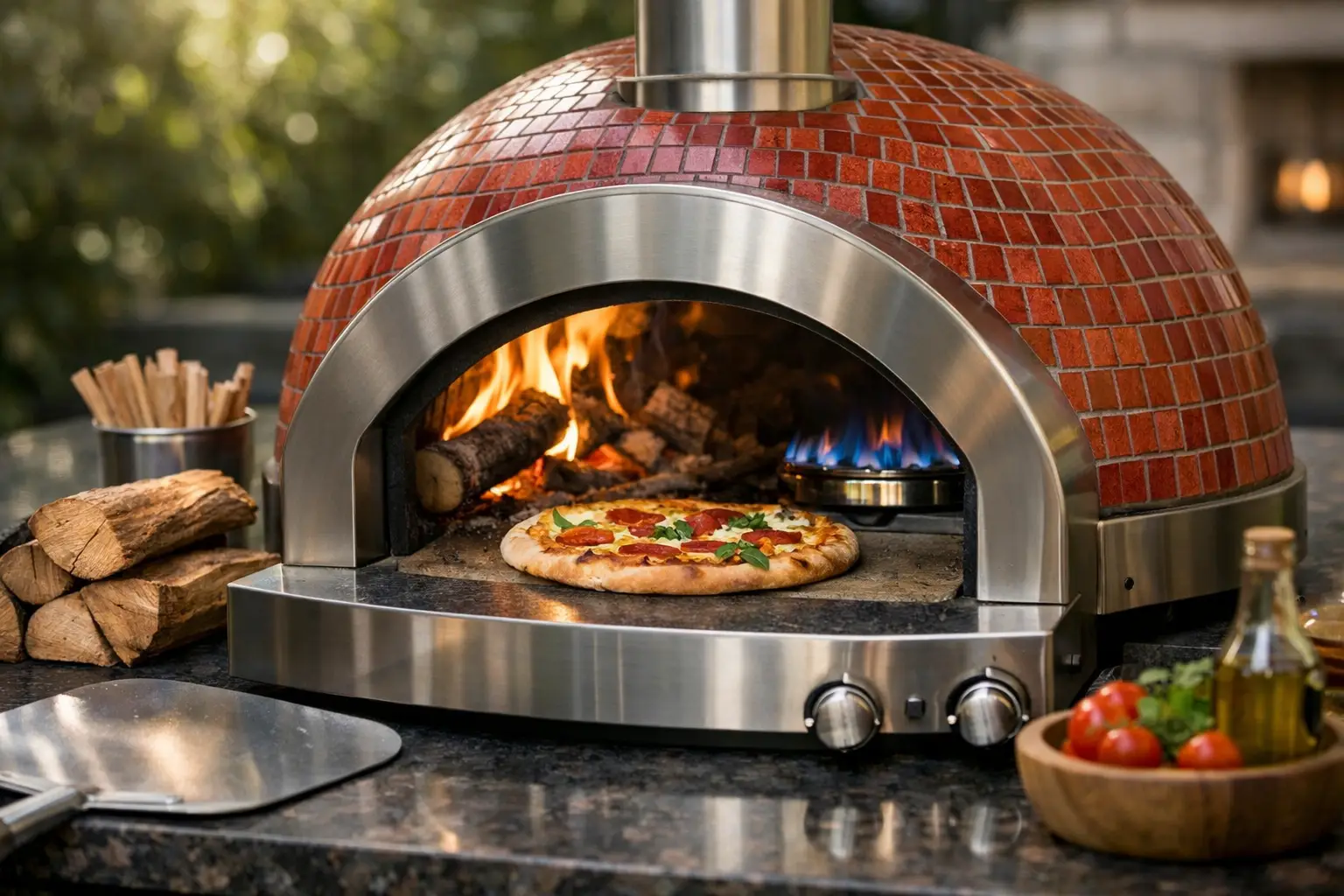
23 Apr Is a Hybrid Wood and Gas Pizza Oven Worth It?
There is a big difference between owning a pizza oven you use twice a summer and owning one that becomes the center of the space. A hybrid wood and gas pizza oven tends to separate those two experiences. It gives you the theater, aroma, and live-fire character people want from a real brick oven, while adding the control and convenience that make frequent use far more realistic.
For luxury homeowners, serious entertainers, and commercial operators, that balance matters. The question is not whether hybrid sounds appealing on paper. It is whether it delivers enough performance, flexibility, and long-term value to justify the investment over a wood-only or gas-only model.
What a hybrid wood and gas pizza oven actually changes
A true hybrid oven is not simply a gas appliance with a decorative flame effect, nor is it a wood oven with an afterthought burner. The best versions are built from the ground up to perform under both fuel methods. That means the chamber, insulation, hearth, and airflow are designed to support authentic high-heat cooking whether you are burning seasoned hardwood, using gas for preheating, or combining both approaches in the same service.
That flexibility changes how the oven fits into real life. On a weeknight, gas can bring the chamber to temperature with speed and consistency. On a weekend gathering, wood can add the visual presence and live-fire cooking experience guests remember. In a commercial setting, gas can help maintain dependable output, while wood adds the traditional character that customers associate with handcrafted pizza.
The result is not compromise when the oven is properly engineered. It is expanded control.
Why buyers choose a hybrid wood and gas pizza oven
Most people are not choosing hybrid because they are indecisive. They are choosing it because they understand that cooking conditions, time constraints, and entertaining goals change.
Wood offers romance, aroma, and a traditional flame pattern that many pizza purists still prefer. It also demands more attention. Fire management takes practice. Heat can vary. Starting from cold takes time. For some owners, that ritual is part of the appeal. For others, it becomes the reason the oven sits idle.
Gas gives you precision. You can preheat faster, recover temperature more predictably, and operate with less effort. For restaurants and hospitality venues, that operational consistency can matter as much as flavor. For residential clients, it often means the oven gets used on ordinary evenings, not only special occasions.
A hybrid wood and gas pizza oven allows you to move between those modes without giving up the core experience of a real masonry oven. That is the appeal. You are not choosing authenticity or convenience. You are choosing both, provided the oven is built to deliver both well.
The performance trade-offs are real
Not every buyer needs hybrid. If you are deeply committed to managing a live wood fire every time you cook, a dedicated wood-fired oven may still be the purest fit. If your priority is quick ignition, minimal cleanup, and highly controlled daily use, a gas-focused oven may suit you better.
Hybrid makes the most sense when your priorities overlap. You want authentic pizza at high heat. You care about presentation. You expect the oven to serve as an architectural feature, not a disposable appliance. And you know there will be times when convenience matters just as much as tradition.
There are trade-offs. A hybrid system is typically more complex than a single-fuel setup. Initial cost is higher. The burner integration must be done correctly. Poorly executed hybrid designs can feel like two half-developed systems sharing one shell. That is why construction quality matters so much in this category.
A premium hybrid oven should never feel like a shortcut. It should feel like a better instrument.
Build quality matters more in hybrid ovens
This is where the buying decision becomes more serious. A hybrid oven asks more of its construction than a lightweight metal unit or mass-market outdoor cooker. It must hold heat like a true pizza oven, withstand repeated thermal cycling, and perform whether the heat source is flame from hardwood, gas, or both.
Real firebrick, proper refractory materials, and substantial insulation are not luxury talking points. They are what make the oven cook evenly and retain heat after the door opens, after multiple pies, and after a long service window. They also affect how the oven ages. An oven built with real masonry has a different sense of permanence. It becomes part of the property, not a seasonal accessory.
For discerning homeowners, that permanence matters aesthetically as well as functionally. A handcrafted oven with architectural finish options, custom tile, and a properly designed enclosure adds visual weight to an outdoor kitchen. It reads as a destination. In high-end residential settings, that distinction is significant.
Where hybrid ovens make the most sense
Residential entertaining and outdoor kitchens
In luxury residential spaces, a hybrid oven works exceptionally well because entertaining is rarely one-dimensional. Some nights call for a full fire, slow conversation, and the ritual of cooking in front of guests. Other nights call for reliable heat at the touch of a control. A hybrid oven supports both without forcing the homeowner to choose one identity for the space.
This is especially valuable in Florida and other warm-weather markets where outdoor kitchens see frequent use. An oven that can preheat efficiently and operate with less effort tends to become part of regular living rather than an occasional novelty.
Restaurants and hospitality venues
Commercial buyers often appreciate hybrid for different reasons. Gas can help support consistency during prep and service. Wood can reinforce brand presentation, menu authenticity, and guest experience. In the right operation, that combination strengthens both workflow and storytelling.
It depends on the concept. A high-volume operation focused on speed and repetition may prioritize gas control more heavily. A boutique restaurant or hospitality venue may value the visual and sensory impact of wood just as much. Hybrid gives operators room to shape that balance around service demands.
Mobile and specialty food concepts
For food trucks, event catering, and specialty concepts, flexibility can be a genuine advantage. Conditions vary from one location to the next. Service windows can be tight. A hybrid setup may offer more adaptability than a single-fuel system, assuming local code requirements and installation specifications are handled correctly.
What to look for before you buy
If you are considering a hybrid wood and gas pizza oven, focus less on the phrase itself and more on how the oven is built. Ask whether the oven is true masonry or a thinner-shell unit dressed up to look substantial. Ask how heat is retained, how the burner integrates with the chamber, and whether performance under wood and gas has been engineered rather than improvised.
You should also consider how the oven will live in the space. Size matters, but not only in terms of cooking capacity. The oven should fit the scale of the property, the outdoor kitchen layout, and the kind of entertaining you actually do. A well-proportioned oven becomes a focal point. An oversized or poorly integrated one can overwhelm the design.
Finish options deserve attention as well. Premium buyers are often choosing an oven that sits beside luxury stone, custom cabinetry, high-end grills, and covered patio structures. In that context, aesthetics are not secondary. They are part of the investment.
This is one reason many clients gravitate toward built-to-order craftsmanship. A custom oven can be matched to the architecture, cooking goals, and installation environment instead of forcing the project to adapt to an off-the-shelf product. Forno Nardona approaches hybrid ovens from that exact perspective, with real brick construction and custom design options intended to perform at a high level while looking fully at home in elevated outdoor spaces.
So, is it worth it?
For the right buyer, absolutely. A hybrid oven earns its place when you want authentic high-heat performance without making every cook dependent on time-intensive fire management. It is especially worthwhile when the oven will be used often, showcased prominently, and expected to deliver both culinary results and architectural presence.
It may be less compelling if your budget is tight, your use will be infrequent, or you strongly prefer a single-fuel experience. But for homeowners building a serious outdoor kitchen, or operators who want both control and live-fire identity, hybrid is often the smartest long-term choice.
The best pizza ovens do more than cook. They shape how a space feels, how guests gather, and how often the experience gets repeated. If you want an oven that respects tradition without making convenience feel like compromise, hybrid is a very strong place to start.