


02 Nov Why a Firebrick Oven for an Open Kitchen Matters
A firebrick oven for open kitchen layouts is never just a cooking appliance. It is a working architectural feature, visible from the dining area, the bar, or the pool deck, and expected to perform under attention. When guests can watch the fire, hear the crust crackle, and smell the wood as a pizza enters the chamber, the oven becomes part of the occasion.
That visibility raises the standard. An open kitchen oven must deliver authentic heat while looking appropriate beside fine stone, custom cabinetry, metalwork, and carefully planned lighting. Real firebrick construction answers both requirements. It creates the thermal environment that wood-fired cooking demands and gives the oven a presence that lightweight, appliance-style alternatives cannot replicate.
Why Firebrick Changes the Cooking Experience
A proper wood-fired oven works by storing energy, not merely producing flame. Dense firebrick absorbs heat during firing and releases it gradually across the cooking floor, dome, and chamber walls. That stored heat is what allows a pizza to cook quickly with a crisp base, lifted crust, and the characteristic leopard spotting associated with Neapolitan-style pizza.
The distinction matters in an open kitchen. A visible fire can be dramatic, but flame alone is inconsistent. If the oven shell and floor do not retain sufficient heat, the operator must continually chase temperature, rotate pizzas more aggressively, and accept uneven results as the oven recovers between orders. Real masonry stabilizes the cooking environment, making the performance more controlled when the room is full and every pizza is on display.
Firebrick also supports versatility after the initial pizza service. Once the peak pizza temperature has eased, retained heat can be used for roasting seafood, vegetables, poultry, breads, and slow-cooked dishes. For a homeowner, that means the oven earns its place beyond pizza night. For a restaurant or hospitality concept, it expands the menu without reducing the oven to a decorative centerpiece.
The Floor Matters as Much as the Dome
The cooking floor is where much of the final result is decided. A true firebrick floor delivers direct conductive heat to the dough while the dome radiates heat downward and the live fire provides top heat. Those forces work together. The result is a pizza that cooks rapidly without leaving the center pale or the underside scorched.
A well-built firebrick oven should be designed as a complete thermal system, with insulation surrounding the masonry and an exterior finish appropriate for its setting. Thick masonry without quality insulation loses heat unnecessarily. Conversely, insulation without substantial firebrick mass cannot create the same cooking character. The balance is what separates a lasting oven from a short-lived visual gesture.
Designing a Firebrick Oven for an Open Kitchen
Open kitchens require a more deliberate design conversation than a standalone backyard oven. The oven must fit the space physically, but it must also fit the way people move, gather, order, and work around it. Its placement should feel intentional from every important sightline.
For a residential kitchen, that may mean positioning the oven near an outdoor dining table while preserving a clear path between prep counters, refrigeration, and seating. In a commercial setting, it may mean making the oven visible to guests without forcing cooks to cross a service lane or reach around the hearth during busy periods. A beautiful oven placed in the wrong workflow can become an obstacle instead of an advantage.
The facade deserves the same attention as the oven chamber. Hand-finished stucco, tile, stone, and custom metal details can align the oven with a coastal contemporary terrace, a Mediterranean courtyard, or a refined indoor dining room. Custom tile color and an engraved faceplate can create a more personal result, but restraint matters. The strongest designs allow the craftsmanship of the masonry and the fire to remain the focus.
Size for the Way You Entertain or Serve
Larger is not automatically better. An oversized oven takes more fuel and time to bring to temperature, which may be unnecessary for an intimate family setting. A chamber that is too small, however, can limit a host who regularly entertains or a restaurant that needs a dependable pace during service.
Consider the number of pizzas you expect to cook at once, the frequency of use, and the dishes you want to prepare beyond pizza. A couple cooking for family may value efficiency and a smaller footprint. A homeowner who hosts large gatherings may prefer a wider floor that accommodates several pizzas and roasting pans. Commercial operators should size from realistic peak demand, staffing, and menu execution rather than the dining room’s visual ambition alone.
Indoor and Outdoor Installation Require Different Decisions
A firebrick oven can be extraordinary indoors or outdoors, but the installation requirements are not interchangeable. Indoor projects demand early coordination with the architect, builder, and qualified ventilation professionals. Clearances, chimney routing, combustion air, structural support, finish materials, and local code requirements must all be resolved before construction reaches the finish stage.
Outdoor installations offer more freedom, yet they still require serious planning. The foundation must support the oven’s considerable masonry weight. The location should account for smoke movement, prevailing winds, overhead structures, nearby materials, and comfortable guest circulation. In Florida and other coastal climates, finishes and surrounding components should also be selected for humidity, salt exposure, and seasonal weather.
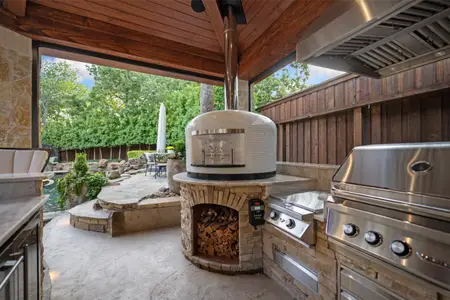
A built-in oven can anchor a complete outdoor kitchen, especially when coordinated with premium grills, refrigeration, storage, counters, and seating. The goal is not to crowd every amenity into one wall. It is to create distinct zones: preparation, live-fire cooking, plating, and conversation. When those zones are planned well, the cook remains part of the gathering rather than disappearing behind it.
Wood-Fired or Hybrid: Choose the Right Rhythm
Wood-fired cooking brings aroma, visual drama, and a direct connection to tradition. For many owners, tending the fire is part of the pleasure. It slows the evening in the right way and gives the cook a role at the center of the experience.
A hybrid wood-and-gas configuration can be the better choice when convenience and operational consistency are equally important. Gas can simplify ignition and temperature management, while wood can still be used when the occasion calls for live-fire flavor and presentation. This is particularly valuable for commercial environments where staff changes, weather, service volume, and prep schedules can make every-minute control essential.
The trade-off is straightforward: wood asks for more attention and technique, while hybrid flexibility adds convenience. Neither is universally superior. The right decision depends on whether the owner values ritual, speed, menu consistency, or all three.
What Premium Construction Protects Over Time
An open kitchen oven is highly visible, which means poor construction becomes visible too. Cracked finishes, weak heat retention, staining around an improperly designed vent path, and an undersized foundation undermine both performance and the investment in the surrounding space.
Handcrafted masonry construction is built for permanence. Quality firebrick, proper refractory materials, layered insulation, and skilled finishing all contribute to an oven that can withstand repeated high-heat cycles. The exterior may be tailored to the project, but the core should remain uncompromising: a genuine masonry chamber built to cook with authority.
Forno Nardona approaches this type of project as both culinary equipment and architectural work. That perspective matters when an oven must perform at high temperatures while serving as the visual heart of a luxury kitchen, restaurant, or outdoor living space.
A Visible Oven Should Earn Its Attention
The best open kitchen designs do not treat the oven as a prop. They give it a purpose, a proportion, and materials worthy of its position. Guests recognize the difference between a flame displayed for effect and a real firebrick chamber built to produce exceptional food.
Start the planning process with the moments you want the space to create: pizzas passed across a counter, a chef working in view of diners, bread emerging from the retained heat after sunset, or a gathering that naturally stays close to the fire. Build around those moments, and the oven will do more than occupy a wall. It will give the kitchen a reason to be remembered.
No Comments