


01 Nov Rustico Pizza Oven Review for Luxury Backyards
A pizza oven can either become the heart of an outdoor kitchen or a handsome object that gets used twice a year. This Rustico pizza oven review focuses on the details that determine which outcome you get: real masonry construction, retained heat, usable cooking space, installation planning, and a design worthy of a finished luxury property.
The Rustico is not positioned as a lightweight, portable appliance. It is a built-to-order, firebrick oven intended for homeowners and hospitality operators who want the presence and cooking character of a traditional wood-fired oven without treating it as a temporary backyard accessory. That distinction matters long after the first pizza night.
Rustico Pizza Oven Review: What Sets It Apart
The defining feature of the Rustico is its true masonry approach. A real firebrick cooking chamber absorbs heat from a live fire, then releases that heat steadily back into the food. This is fundamentally different from a thin metal enclosure that heats quickly but loses temperature the moment the flame settles.
For pizza, retained heat means a properly fired floor can cook a crisp, leopard-spotted crust while the dome reflects intense heat onto the toppings. For the cook, it means less chasing the fire between every pie. Once the oven is saturated with heat, the experience becomes more controlled and more rewarding.
That thermal mass also expands the oven’s purpose beyond Neapolitan-style pizza. After the peak pizza session, the declining heat is well suited to roasted seafood, vegetables, cast-iron dishes, baked breads, and slow-cooked meats. An oven with meaningful mass earns its footprint because it can support an entire evening of cooking, not just a single course.
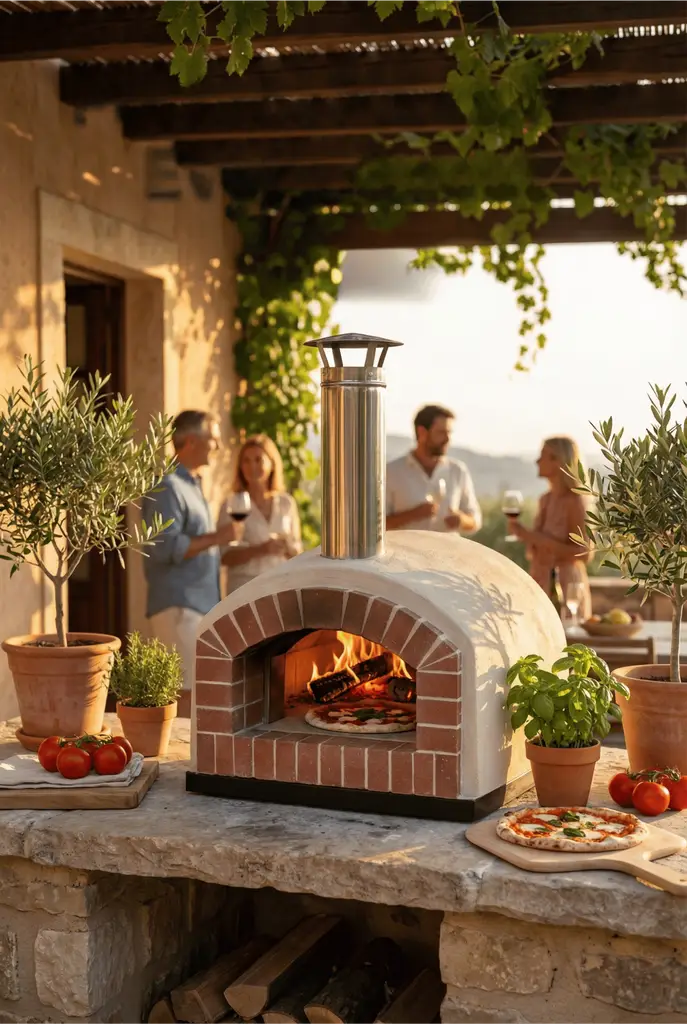
The Rustico also carries the visual language that many outdoor kitchens lack: depth, material presence, and a visible connection to old-world cooking. Its curved dome and substantial face make it an architectural element. On a terrace, pool deck, or covered lanai, that presence can anchor the layout in the same way a fireplace anchors an interior room.
Construction Is the Real Value Question
Luxury buyers are right to look beyond an oven’s exterior finish. Tile color and decorative details matter, but the materials below the surface determine whether an oven remains dependable through years of firing, weather exposure, and entertaining.
A firebrick oven is designed to handle repeated high-heat cycles. The chamber, insulation, and exterior finish must work together so heat stays where it belongs – in the oven – rather than escaping into the surrounding structure. Effective insulation helps the Rustico reach cooking temperature efficiently and helps preserve usable heat after the fire has reduced to embers.
That is particularly valuable for homeowners who entertain. A properly heat-soaked oven gives the host breathing room. Instead of managing an erratic heat source while guests wait, the cook can maintain a steadier rhythm: launch, turn, retrieve, repeat. The result is a better pizza and a more relaxed gathering.
Durability is not only about the dome. The base, landing area, venting path, enclosure, and weather protection all deserve attention. A custom oven should be designed as part of the larger build, with appropriate support and clearances from the beginning. Retrofitting a heavy masonry oven into an outdoor kitchen after countertops and utilities are complete is rarely the elegant path.
How the Rustico Performs in Real Use
Wood-fired pizza requires a small amount of skill, and that is part of its appeal. The Rustico rewards owners who learn to read the fire, the floor, and the dome. A lively flame drawn across the top of the chamber cooks the upper surface of the pizza, while the heated firebrick floor creates the structure underneath.
The first few firings are also a practical education. New owners should follow the recommended curing process, using gradually increasing fires to remove residual moisture from the masonry. Rushing this stage can compromise even a well-built oven. Once cured, the oven becomes more predictable with every firing as the owner learns its preferred fuel load and cooking zones.
For a typical pizza service, fire management is straightforward but active. The fire is moved to one side or toward the back, leaving a clear section of floor for cooking. Pizzas are rotated as the crust sets, taking advantage of the hotter area nearest the flame. This hands-on process is not a drawback for the right buyer. It is the theater that turns dinner into an occasion.
There is a trade-off. A masonry oven takes longer to preheat than a compact gas appliance, and wood-fired cooking creates ash, smoke, and a learning curve. Buyers who want instant weeknight pizza with no preparation may prefer a hybrid configuration where appropriate. Buyers who value the aroma of burning hardwood, the visible flame, and the deeper character of live-fire cooking will see the preparation as part of the ritual.
Design Options Matter More Than Decoration
The Rustico belongs in a carefully considered outdoor environment. Its finish can be selected to complement natural stone, stucco, porcelain pavers, painted millwork, or a fully tiled kitchen wall. The goal is not to make the oven disappear. It is to make it look intentional.
Custom tile colors and engraved faceplate details give homeowners a way to connect the oven to the property’s architecture. A coastal home may call for a lighter, more tailored palette. A Mediterranean-inspired courtyard may suit warmer tones and a more expressive finish. The best choice depends on the surrounding materials, sunlight, and how prominently the oven sits within the entertaining area.
Scale matters just as much. An oven that feels commanding in an open poolside kitchen may overwhelm a narrow patio. Conversely, an undersized oven can look visually lost beside a substantial grill island, refrigeration, and stone bar. The oven should be planned alongside seating circulation, prep space, fuel storage, and the route from kitchen to outdoor cooking area.
Forno Nardona approaches this as an outdoor-living decision, not a product placed at the end of a countertop. That perspective is especially useful when the oven will be a focal point for a new build, renovation, or hospitality space.
Installation Considerations Before You Commit
The Rustico is best for buyers prepared to build around performance. Start with the structure. A masonry oven is heavy and requires a properly engineered, level foundation or support system. Do not assume an existing deck, decorative cabinet run, or patio slab is automatically suitable.
Next, consider placement. The oven should be close enough to the entertaining area to encourage use, yet positioned with sensible attention to smoke, prevailing wind, overhead structures, and local requirements. A wood-fired oven becomes more enjoyable when the person tending the fire remains part of the conversation rather than isolated at the edge of the property.
Think through workflow as well. There should be a generous landing area for placing hot pans and turning pizzas, nearby prep space, and practical wood storage that stays dry without becoming visually cluttered. Commercial users should take this a step further by considering service volume, ventilation, staffing movement, and the number of pizzas expected during peak periods.
Indoor installations and certain covered applications require particularly careful planning. Venting, clearances, noncombustible materials, and local code compliance must be addressed before the oven is specified. This is where professional design and installation guidance protects both the investment and the finished appearance.
Who Should Choose the Rustico?
The Rustico makes the strongest case for buyers who want a permanent cooking centerpiece with authentic wood-fired character. It suits the homeowner who hosts often, values material craftsmanship, and wants guests to gather around something more memorable than a standard grill. It also suits restaurants, private clubs, resorts, and caterers that want the performance and visual credibility of a true brick oven.
A brick oven like the Rustico may be less suitable for someone with very limited outdoor space, a temporary living situation, or no interest in tending a real fire. Those are not shortcomings of the oven. They are simply signs that a substantial masonry piece should be chosen for the right setting and lifestyle.
The most satisfying Rustico installations are planned as destinations. Give the oven enough room, pair it with serious prep space, choose finishes that belong to the architecture, and make the first firing an event. A real firebrick oven does more than cook pizza – it gives people a reason to stay outside a little longer.
No Comments