


30 Oct Vesuvio Pizza Oven Review for Luxury Outdoor Living
A serious outdoor oven should not feel like a seasonal appliance rolled out for a few weekend pizzas. It should hold a live fire with authority, produce the blistered crust and tender interior that define true Neapolitan-style pizza, and look fully at home within a considered outdoor kitchen. That is the standard behind this Vesuvio pizza oven review. The Vesuvio is designed for buyers who see wood-fired cooking as both a culinary pursuit and a permanent architectural investment.
What the Vesuvio Is Built to Be
The Vesuvio is not intended to imitate a traditional masonry oven with a thin shell, decorative finish, or quick-heating compromise. Its character starts with real firebrick construction. Firebrick absorbs, stores, and radiates heat in a way that changes the cooking experience: the floor recovers quickly between pizzas, the dome maintains an even cooking environment, and retained heat continues to work long after the visible flame has settled.
That distinction matters when guests are waiting, dough is proofed, and the oven needs to do more than produce one attractive pizza. A properly heated masonry oven supports a rhythm of cooking. You can bake pizza close to the fire, move into roasted vegetables or seafood as the oven moderates, then use the falling heat for bread, braises, or dessert. The oven becomes a working hearth rather than a single-purpose centerpiece.
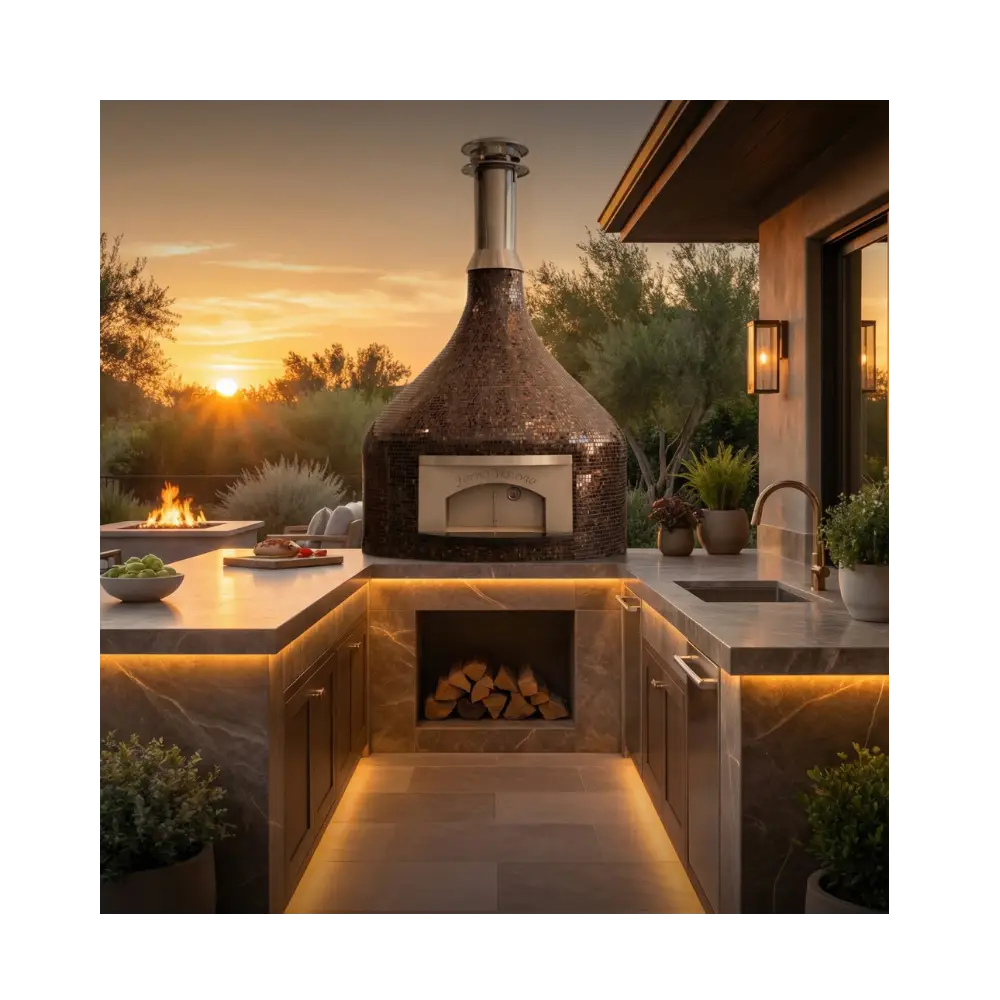
The Vesuvio also carries the visual presence expected of a luxury outdoor installation. Its domed form, finished face, and customizable details give it architectural weight. In a well-designed patio, pool area, or covered lanai, that presence is not incidental. The oven often becomes the element that gives the entire kitchen its point of view.
Vesuvio Pizza Oven Review: Cooking Performance
The strongest reason to choose a masonry oven is not nostalgia. It is thermal mass. When real firebrick is thoroughly saturated with heat, it delivers energy from the cooking floor and the dome at the same time. That is what helps create a crisp, leopard-spotted base while melting cheese and finishing toppings before the center of the crust dries out.
A Vesuvio oven rewards the cook who learns fire management. For high-heat pizza, the fire is built and maintained to one side, leaving a clean cooking zone across the hearth. Pizzas are turned deliberately as the flame rolls across the dome. This process is active, visual, and satisfying, but it is not push-button cooking. Those who want a completely hands-off appliance may be better served by a different category of outdoor equipment.
For owners who value control, however, the learning curve is part of the appeal. Wood choice, coal bed, fire position, door use, and the timing of each turn all make a visible difference. A wood-and-gas hybrid configuration can be a sensible option for households or food-service settings that want the character of live-fire cooking with faster, more repeatable ignition. The right fuel arrangement depends on how often the oven will be used and who will be running it.
Heat retention changes the menu
Many outdoor pizza ovens are judged only by how rapidly they reach pizza temperature. That is an incomplete test. A better question is what happens after the first round of pies.
The Vesuvio’s masonry construction is meant to retain usable heat, allowing a host to cook through an evening instead of constantly chasing temperature. After pizza service, residual heat can carry a cast-iron pan, a tray of roasted tomatoes, a whole fish, or a crusty loaf of bread. For homeowners who entertain often, this turns one firing into a full meal rather than a short demonstration.
Commercial operators benefit from the same principle, though their needs are more demanding. Consistent output, recovery between orders, workflow around the oven mouth, and ventilation planning all matter as much as peak temperature. A Vesuvio can make a memorable visual statement in a restaurant, hospitality venue, catering setting, or food truck, but commercial success depends on selecting the appropriate size and installation plan from the start.
Craftsmanship and Finish Are Part of the Value
Luxury buyers are right to look beyond a product photo. The materials behind the finish determine whether an oven simply looks substantial or actually is substantial. Real masonry construction adds weight, permanence, and cooking capability. It also calls for a proper foundation and a thoughtful site plan.
The finish is where the Vesuvio can be tailored to the surrounding architecture. Tile color, faceplate details, and complementary outdoor-kitchen materials allow the oven to feel integrated rather than added on at the end. A Mediterranean-inspired courtyard may call for one expression; a clean coastal terrace or contemporary covered patio may call for another. The best result is not necessarily the most ornate one. It is the one that looks inevitable in its setting.
This is particularly valuable when the oven is part of a larger custom kitchen. Counter height, landing space, refrigeration, grill placement, lighting, and traffic flow all shape how enjoyable the oven will be to use. An oven can be beautifully built yet awkward in practice if there is nowhere to stage dough, set down hot cookware, or let guests gather without standing in the cook’s path.
Installation Is Where Good Decisions Become Lasting Ones
A Vesuvio is a permanent piece of masonry equipment, and it should be planned accordingly. The foundation must be engineered for the oven’s weight. Clearance requirements, chimney routing, local code, wind exposure, and overhead structures must be considered before construction begins. If the oven is going beneath a roofline or within a screened enclosure, ventilation design becomes especially important.
Indoor installations demand another level of coordination. Venting, combustible clearances, makeup air, floor loading, and local approvals are not details to solve after delivery. They are part of selecting the right oven and site. The same is true for commercial projects, where fire protection, health requirements, production volume, and staff workflow influence every decision.
Florida’s humid climate and coastal conditions add practical considerations for outdoor living. Finishes, surrounding materials, drainage, and protective design should be chosen for the environment, not simply for a showroom image. A custom-built oven deserves a setting that protects its performance and preserves its finish over time.
Who Should Choose the Vesuvio?
The Vesuvio is well suited to the homeowner who wants a true focal point for entertaining and is prepared to give the oven a permanent, well-designed home. It suits cooks who appreciate the ritual of tending a fire, serving pizza directly from the hearth, and extending the meal with food cooked on retained heat.
It is also a compelling choice for businesses that want their cooking process to be part of the guest experience. A visible brick oven communicates craft before a plate reaches the table. Still, it is not automatically the right choice for every project. Limited access, a lightweight deck, restrictive site conditions, or a need for purely instant operation may point toward a different configuration or a different oven line.
The right buyer is not looking for the smallest possible footprint or the fastest shortcut to a pizza. They are looking for the real thing: a handcrafted oven with the heat behavior, visual authority, and long-term substance to earn its place in the property.
The Verdict for a Long-Term Outdoor Kitchen
This Vesuvio pizza oven review comes down to a simple measure: does the oven offer more than a momentary novelty? With real firebrick at its core, the Vesuvio is designed to do exactly that. It brings the thermal performance needed for exceptional pizza, the retained heat needed for broader cooking, and the customization needed for a refined outdoor setting.
Forno Nardona builds the Vesuvio for projects where craftsmanship is visible, performance is felt in every bake, and the outdoor kitchen is meant to become part of the home’s legacy. Plan the site carefully, choose the size and fuel configuration around the way you truly cook, and the first fire can be the beginning of a tradition rather than the highlight of a single evening.
No Comments